
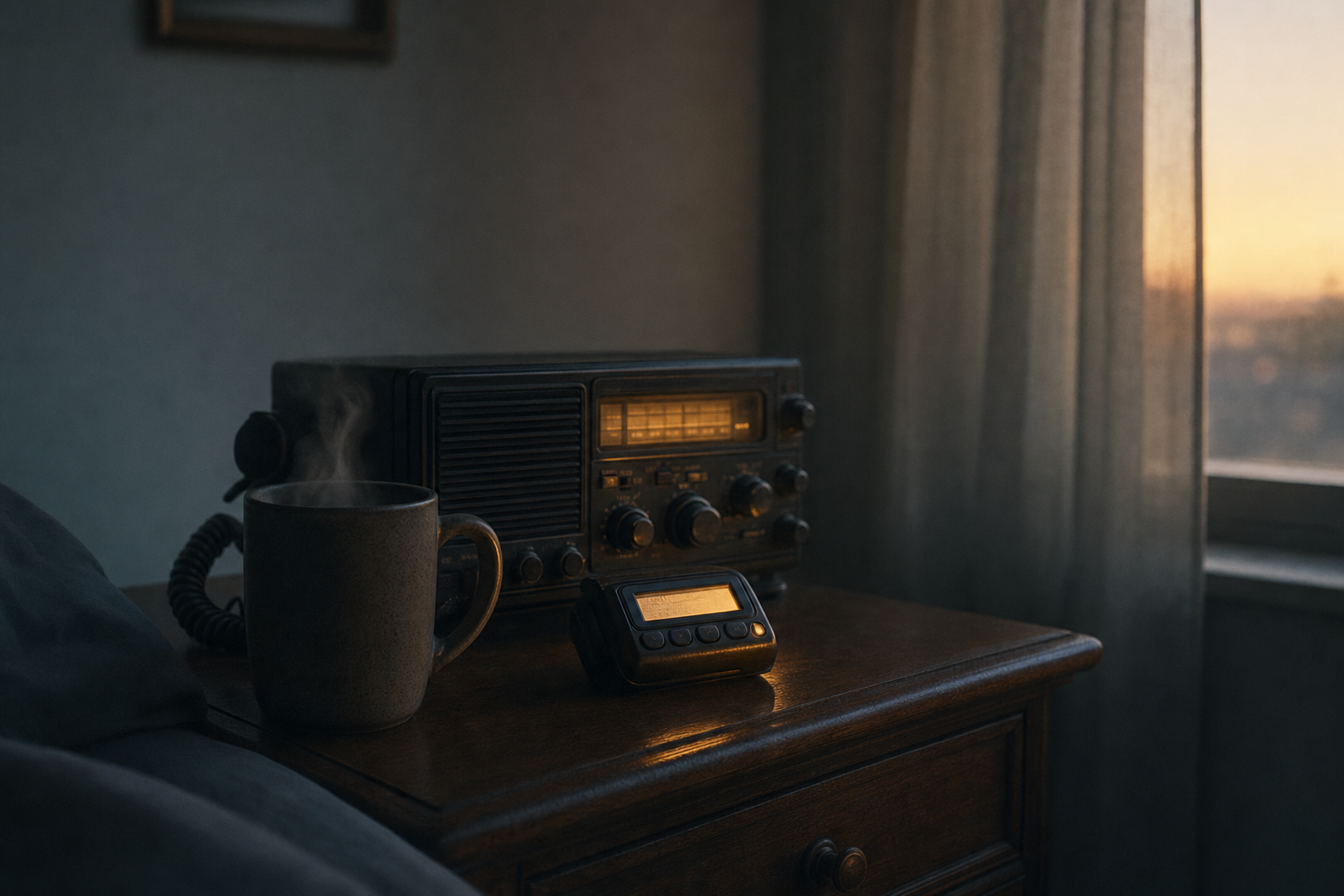

Twenty years later, I still wake up half-expecting a page. Some habits outlast the job that built them, and this is one of mine. My wife will tell you I still sleep with one ear open, like my brain never got the memo that I turned in the pager years ago. Old dogs, old tricks. You know how it goes.
I was a First Responder Chaplain for fire, police, and search and rescue for a long stretch of my life. Long enough that the sound of a radio crackling to life still does something to my nervous system that coffee never could. Long enough that I can hear a siren three streets over and my whole body braces before my brain even catches up. Long enough that "off duty" was always more of a suggestion than an actual state of being.
Here's the thing nobody tells you about that kind of work: it doesn't clock out with you. You can hang up the radio, turn in the badge, retire the title, and move to a quiet house in Boise where the loudest thing most nights is the neighbor's sprinkler system — and some part of you is still standing at attention, waiting for the next call. It's like your body signed a contract your mind never got to read.
What Twenty Years of "Ready" Does to a Person
I used to think this was a flaw. Something broken that needed fixing. A switch I should've been able to flip off the day I walked away from the job.
Then I got older, sat with it a while, and realized something: readiness isn't the problem. Readiness is what kept me useful for two decades. The problem is thinking readiness and rest can't live in the same house.
That's a lie, by the way. A convincing one. But a lie.
I spent years standing next to people in the worst five minutes of their lives — a hospital hallway, a rollover on the interstate, a family waiting by a riverbank at two in the morning hoping search and rescue would bring back good news. In those moments, you don't get to be halfway present. You show up fully, or you shouldn't show up at all. I learned that the hard way, more than once.
But here's what took me longer to learn: the same wiring that made me good in a crisis is exhausting to live with full-time. You cannot run a household, a marriage, or your own soul on "crisis mode" forever. Eventually something's got to give — and if it's not the wiring, it's you.
Faith Doesn't Turn the Radio Off Either — But It Changes What You Do With It
I'll be honest with you, because that's the only way I know how to write anything worth reading: my faith didn't magically silence the part of me that's still listening for a page. God didn't reach down and rewire twenty years of training in one prayer. That's not really how any of this works, and if someone's promised you it does, I'd ask a few more questions before you believe them.
What faith did — what it still does — is give that readiness somewhere to go besides my own shoulders.
There's a verse I've leaned on more than most: "Cast all your anxiety on him because he cares for you" (1 Peter 5:7). For a long time I read that and thought it meant "stop worrying," which, respectfully, is a nice idea and also completely useless advice to a guy whose brain is still wired for sirens. What I've come to understand instead is that it means I don't have to be the one holding the pager anymore. Somebody bigger than me is already on shift. Always has been. I just spent two decades forgetting that, because the job trained me to believe I was the last line of defense.
I wasn't. I never was. I was just present. That's it. That was always the whole job — showing up, staying steady, and trusting that the outcome was never fully in my hands to begin with. Turns out that's not a bad way to live a whole life, not just a shift.
The Slow Burn Version of the Same Skill
These days, my "calls" look a lot different. A cigar on the back patio instead of a stretcher in the driveway. A conversation with another guy who's carrying something heavy, instead of a family in a waiting room. The skill is the same — show up, be present, don't flinch — just aimed at a much quieter target.
And honestly? The quiet took some getting used to. When your whole nervous system was trained on adrenaline, peace can feel suspicious at first, like it's hiding something. I had to relearn that calm isn't the enemy. Calm isn't a sign that something's about to go wrong. Sometimes calm is just... calm. Wild concept, I know.
That's the whole idea behind the Oasis, if I'm being honest. It's not that I stopped being ready. It's that I finally found something worth being ready for besides the next emergency — my faith, my family, a fire pit, and the guys who show up to sit around it.
So, Twenty Years Later
I still wake up half-expecting a page some nights. I probably always will, and I've made peace with that. But these days, when I hear that phantom radio crackle in the back of my mind, I don't brace for the worst anymore. I just say a quiet thanks that I get to sit still for a while, and I go make coffee.
Old habits don't always need to be broken. Sometimes they just need a better job to do.
Come sit with us for a while. Follow along on Instagram, Facebook, and Twitter/X — I'm there most days, coffee in hand, still listening for something worth showing up for.
And don't forget to visit BrownsLifeOasis.com: https://wwwBrownsLifeOasis.com, for more articles on faith, family, and finding your rhythm in a chaotic world.