
Review of the Rocky Mountain Cigar Festival 2026
If you're part of our regular circle back at the Oasis, the ones who show up on lounge nights with a chair already claimed in their head before they've even parked, you know we don't do these write ups as marketing copy. We do them because somebody has to keep the record straight. So pour something, light something, and let's walk through it: why this thing relocated in the first place, what the venue actually looked like, what there was to do, who showed up to sell us things, a detour to a lounge that had no business being as good as it was, how the cigars themselves behaved under fire, whether it was worth the money, what to drink alongside what you smoked, and how this stacked up against every other regional festival we've hauled ourselves into over the years.
How a Cigar Festival Ends Up in Cheyenne, Wyoming
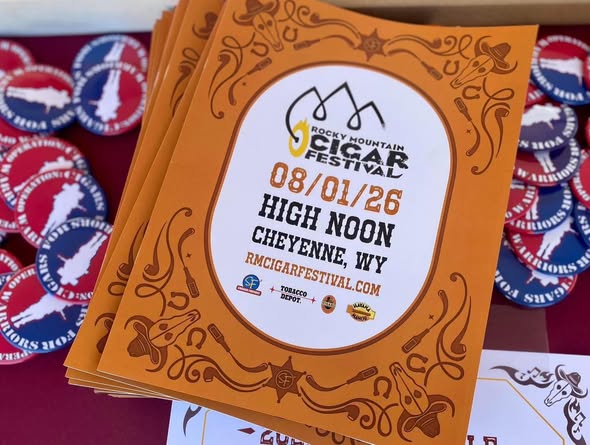
This is worth explaining up front, because it's the most interesting thing about this year's event and most people showing up cold had no idea it happened. The Rocky Mountain Cigar Festival has run in Colorado for the better part of two decades, this was its seventeenth year, and for 2026, the organizers at Smoker Friendly moved both this festival and their trade only Smoker Friendly Conference and Tobacco Festival north into Wyoming, running them back to back at the same property.
The short version of why: Colorado's smoking and drinking regulations kept tightening year over year, to the point where a mobile cigar lounge that used to travel with the event got shut down by the state entirely. At some point you stop fighting the regulatory tide and start looking at a map for friendlier ground. Wyoming pitched itself, correctly, as more accommodating to an event built entirely around lighting things on fire and handing people drinks while they do it, and the organizers took the deal. Cigars at this year's festival were sold at MSRP with Smoker Friendly eating the state and sales tax on top of it, which is the kind of detail that tells you this wasn't a reluctant, half hearted relocation , they built the economics of the move to actually benefit the people showing up.
There was some grumbling about this on the cigar forums beforehand, and we'll admit we laughed along with it: a festival with “Rocky Mountain” in the name, now held on a stretch of high plains where the closest thing to a mountain is a grain elevator and a healthy imagination. We're not above pointing that out ourselves. But nobody in our crew cared enough about the geography lesson to skip the trip, and after two days there, none of us think the name is what mattered anyway.
For those of you who made the trip to the old Colorado venue in past years, the contrast is worth noting honestly rather than glossing over. The previous grounds sat close enough to the Front Range that the mountains actually framed the skyline behind the vendor tents, which was a genuinely gorgeous backdrop we won't pretend Cheyenne replaces. What Cheyenne traded that view for was breathing room, a regulatory environment that let the whole event operate without a state official eyeing the drink tickets, and a property willing to lean all the way into hosting instead of just tolerating it for a weekend. We'd call that a fair trade, even if the postcard photos look a little different this year. The drive itself barely registers as a complication either, Cheyenne sits a little over an hour north of Denver, which meant more than a few attendees treated this as a day trip up from Colorado rather than a genuine relocation of loyalty.
The Venue: A Prairie Resort Playing Genuine Host
The festival set up at the Little America Hotel & Resort, a sprawling property just outside downtown Cheyenne that describes itself, in its own marketing, as a kind of oasis dropped into the middle of the Wyoming prairie, which, coming from a site literally named the Oasis, felt less like a coincidence and more like the universe handing us an easy joke and daring us not to take it.
And it earns the description more than you'd expect from a hotel sitting on open grassland. Someone decided decades ago that this property needed real trees, and pine trees now stand thick enough across the grounds that you occasionally forget you're surrounded by prairie until the wind reminds you. There's a freeform outdoor pool with a sunbathing deck that had guests parked in loungers all weekend, a nine hole golf course sharing its fairways with actual pronghorn antelope and a rotating cast of ducks who did not seem to care whose backswing they were interrupting, and horseshoe pits and cornhole boards scattered around the grounds for anyone who wanted a break between cigars. Inside, the lobby runs a fireplace and live piano most evenings, which meant more than one of us ended up parked in a leather chair by that fire at eleven at night, cigar long gone, just listening, because that's apparently what fifty year old men do now when given the option.
It's the kind of property that works precisely because it doesn't try to fight where it is. It leans into the plains instead of apologizing for them, and somewhere in that decision is the same instinct behind everything we do back home, you don't need dramatic scenery to build somewhere worth sitting still in. You just need enough shade, enough chairs, and people willing to occupy them with you.
What There Was to Do
The public festival itself ran a tight window, General Admission and Social ticket holders got the grounds from noon to six, VIP and Executive VIP tiers got an extra hour on the front end starting at eleven, which is shorter than some of the marathon festivals we've attended, and honestly, we came around on that. Six hours of focused smoking, eating, and vendor conversation beats twelve hours of slow fade where the back half turns into a test of endurance rather than enjoyment.
Inside that window, the structure was straightforward and effective: full access to walk the manufacturer rows, meet the actual master blenders and company reps standing behind their own product instead of hired booth staff reading from a script, food and drink service running the whole time, and a drawing ticket in every festival bag for an end of day prize raffle that had our crew's incurable optimist checking his phone for the results well after we'd already left the grounds. Update, no I did not win anything this year. Live entertainment ran through the afternoon on the property, providing exactly the kind of background presence a festival like this needs , there to fill the space, not there to compete with the hundred plus conversations happening in front of every booth.
The festival didn't exist in isolation, either. The week built up to it, a brewery tour a few nights before pulled in the early arrivals, and Friday night carried its own separate ticketed events with two of the bigger manufacturer names throwing their own gatherings elsewhere on the property, which is a whole write up of its own and not one we're duplicating here. Saturday evening, once the main festival gates closed, an informal tailgate with lawn games picked up right where the ticketed day left off, and that's genuinely where some of the best conversations of the whole trip happened, fewer people, lower stakes, cigars from earlier in the day still working their way through everyone's system.
A Pit Stop at Smoker Friendly Smoking Lounge and Humidor
Here's the part of the trip nobody warned us about, and it turned into one of the actual highlights of the weekend: a visit to the Smoker Friendly Smoking Lounge and Humidor over on the east end of Lincolnway, a few minutes from the festival grounds.
From the parking lot, it doesn't oversell itself. It sits in an ordinary strip of retail storefronts, the kind of exterior you'd drive past a hundred times without a second look if you didn't already know what was inside. That's precisely why walking through the door caught us off guard. The retail floor opens up bright and uncluttered, and behind it sits a genuinely serious walk in humidor, deep enough in stock and spread wide enough across price points that our crew's most particular smoker, the one who reads every wrapper like he's appraising a used car, spent a solid twenty minutes in there without saying a word to anybody, which for him is the highest compliment available.
Past the humidor, the lounge itself is a room full of leather chairs and a sofa arranged so conversation happens naturally instead of requiring anyone to shout across a gap, the sort of layout that tells you somebody who actually smokes designed it, rather than somebody who just sells to people who do. The staff struck exactly the right balance, present enough to answer a real question the second you had one, invisible enough that you never felt like you were being upsold on a cutter you didn't ask about. We went in for what we told ourselves would be a quick stop to grab a few sticks before the festival gates opened. We left three hours later, having bought considerably more than “a few,” because that's what happens in a room built correctly for sitting still, the clock stops mattering and nobody in the group is the one willing to be the reason everyone leaves.
The inventory itself deserves its own mention. This wasn't a humidor padded out with whatever the distributor was pushing that month, the price points ran wide enough to send our budget conscious member home happy and our splurge first member home happier, and the pipe tobacco selection tucked into one corner was deep enough that one of our crew, who hasn't touched a pipe in years, spent ten minutes talking himself back into the hobby before talking himself back out of it by the register.
If you make the trip out to Cheyenne for this festival next year, budget an actual chunk of time for this stop rather than treating it as an afterthought on the way to somewhere else. It earned its spot on the itinerary more than a few of the officially ticketed activities did.
Vendors: A Hundred Plus Reasons We Didn't Sleep Enough
Even accounting for the move, the manufacturer turnout barely blinked, somewhere north of a hundred vendor operations set up across the grounds, and by our count, nearly the entire roster that's shown up in past years made the trip to the new location with them. Only one name we'd expect to see sat this one out, due to a scheduling conflict rather than any dissatisfaction with the move, and word among the regulars is they'll be back next year. That kind of continuity matters more than it sounds like it should, it means the relocation was a change of address, not a fracture in the community that built this thing over seventeen years.
One detail that genuinely impressed us: Smoker Friendly's own staff worked point of sale for the manufacturer booths directly, which kept transactions moving fast even during the after lunch rush when every aisle filled up at once. Combined with the MSRP, plus no tax pricing, buying at this festival felt less like the usual festival markup game and more like the organizers had actually sat down and asked what would make attendees walk away happy rather than squeezed.
The range on display ran the full spectrum, the manufacturer names you'd recognize from any shop's top shelf, standing shoulder to shoulder with smaller outfits running a card table and a cooler, the kind of operation where the person pouring your sample also has a direct hand in growing or rolling what's in it. That mix is what keeps a festival like this from turning into either a trade show with better lighting or an overwhelming maze of unfamiliar names with no anchor points. You could walk in knowing nothing and leave with a favorite. You could walk in as a twenty year veteran and still find something you hadn't tried.
Because this festival runs back to back with the trade only Smoker Friendly Conference and Tobacco Festival, a retailer focused gathering pulling in several hundred authorized dealers from around the country, marking its own thirtieth anniversary this year, a lot of the manufacturer reps working the consumer festival had already spent two full days in Cheyenne talking shop with shop owners before the public ever showed up. That overlap showed in small, welcome ways. The people behind the tables weren't running on their first coffee of a long weekend; they'd been in town, in the rhythm of talking about their own product, long enough that conversations at the booths felt less like a rehearsed pitch and more like picking up a conversation already in progress. We've been to festivals where the vendor energy visibly craters by hour four. That never happened here.
Technical Aspects: How the Cigars We Actually Smoked Performed
This is the part that separates an actual review from a highlight reel, so let's get into it. Between the four of us, over the two days in Cheyenne, counting the festival, the Smoker Friendly stop, and the tailgate that followed, we worked through close to twenty different sticks, and the performance spread was wide enough to be genuinely interesting rather than uniformly good.
The standout of the weekend came out of the Smoker Friendly humidor: a Plasencia Reserva Original, a medium-bodied stick with a wrapper that had a faint sheen to it, almost like it had been polished rather than just cured. The draw was what I'd call unhurried, not loose, not fighting you, just willing to give up smoke at its own comfortable pace, like it had already decided how the next hour was going to go and saw no reason to rush the plan. The burn line held together with almost stubborn precision, needing only a single light touch-up across the whole smoke, and the ash built in clean, dense gray rings that held on well past the point where you'd expect gravity to have an opinion about it. Flavor-wise, it opened bright and almost citrus-forward, which is not where you expect a medium-bodied cigar to start, and by the midpoint had rolled into a deeper, toasted-grain warmth with a thread of black pepper running underneath the whole way, like a bassline you don't consciously notice until someone points it out and then you can't unhear it. Coming from a family that's been growing tobacco in Nicaragua longer than most of this festival's attendees have been alive, it earned the standout slot honestly.
Contrast that with a West Tampa Tobacco Co. we picked up from one of the manufacturer booths at the festival, which had all the confidence of a blend that knows it's popular and none of the patience to earn it fresh with every smoker. Good cigar, don't get me wrong, but the draw ran tight enough in the final third that it felt like the cigar was clenching its jaw at you, and the burn needed three separate corrections to stay honest. Strong, peppery, leather-forward the whole way through with barely any evolution, which some of our crew loved specifically because they wanted something that didn't ask them to think, and some of us found a little one-note by the last inch.
An Apostate "The Lost Pages," the cigarillo release from that same craft outfit, turned out to be one of the most surprising smokes of the whole trip, small enough to finish in the time it took to walk one side of the vendor rows, but it never once felt like a scaled-down version of something bigger. The burn ran clean and even from first light to last inch, no touch-ups needed, which at that size is easy to take for granted until you've had one that didn't manage it. Flavor came on fast and stayed dense the whole way through, a rich, nutty, almost toasted-bread quality that a full-sized cigar would need twenty unhurried minutes to develop, packed instead into something you could finish standing up mid-conversation. It became the cigar our crew's most skeptical member kept bumming off everyone else's stash for the rest of the weekend, which is about as close to a five-star review as he's capable of giving anything out loud.
A fourth stick, picked up during that after-lunch rush at one of the manufacturer booths, was an Espanola 1996 Connecticut, a mild-to-medium blend wrapped in something almost golden, closer to the color of weak tea than the usual range of browns on a table like that. The draw ran a touch loose for my taste, giving up smoke almost too willingly, like it was eager to please rather than confident enough to make you work for it. But the flavor made up for the construction quibble, a cream-and-hay sweetness up front that gradually picked up a faint cocoa note in the back half, never aggressive, never demanding, the kind of cigar you'd hand to someone just getting into the hobby because it teaches patience without punishing inexperience.
The last one worth logging came out of the tailgate on Saturday evening: a Kristoff Tres Compadres, short and stocky with a thick ring gauge and a dense pack, the kind of stick that looks like it's compensating for something until you actually light it. It wasn't. The burn ran arrow-straight from cap to nub with zero intervention needed, which after an afternoon of touch-ups on other sticks felt almost suspicious, like the cigar knew exactly what it was doing and had decided not to make a show of it. Flavor-wise it stayed remarkably consistent start to finish, a dry, almost mineral quality with a slow-building warmth underneath, less a transition than a steady simmer that never quite boiled over.
Value Assessment: Was It Worth the Money
Let's talk numbers honestly, because the tiered pricing on this one was more layered than most festivals bother with, and it's worth breaking down for anyone deciding whether to make the trip next year. The entry level Social ticket ran $85 and got you into the grounds, a meal, a taster cup, water bottle, and t-shirt a fine option if the cigars themselves aren't the main draw for you. General Admission stepped up to $225 and added a genuinely stacked cigar allotment on top of the same festival extras, plus a cutter and lighter in the bag. Above that sat three VIP tiers, a VIP Social at $185, a full VIP at $350, and a fifty five person Executive VIP at $650, each adding earlier entry, more cigars, dedicated lounge access, and more drink tickets as you climbed. All three of those upper tiers sold out well before the festival, which tells you the organizers priced this thing correctly for the demand it had.
Factor in the MSRP, with no tax pricing at every vendor table, the meal included in every tier, and the fact that the cigar allotment alone in the General Admission bag covers a meaningful chunk of the ticket price in retail value before you buy a single additional stick, and this wasn't a festival built to squeeze a captive crowd. Add the practical costs of the trip, gas, one hotel night because none of us are young enough anymore to drive home the same night without regretting it, food outside what the ticket covered, and the total landed at a number that felt entirely fair against what we walked away with in cigars, a genuinely well-run event, and a story we'll be telling at lounge nights well into next year.
Pairing Suggestions: What We Drank Alongside What We Smoked
Pairing is one of those things everybody has opinions about and nobody fully agrees on, so take this as a report from the field rather than gospel. The bright, citrus opening standout from the Smoker Friendly humidor did something unexpectedly good alongside a dry Riesling someone had brought along in defiance of the unofficial “beer and bourbon only” rule our group usually operates under, the wine's acidity met the cigar's early brightness and actually amplified it rather than fighting it, then got out of the way gracefully once the smoke moved into its deeper, toasted phase.
The full bodied, leather forward stick from the festival floor wanted something with weight behind it, and a well aged rye handled that assignment without complaint, the spice notes in the whiskey and the pepper in the smoke were clearly cut from similar cloth, and together they didn't so much complement each other as agree to keep pace with one another all the way through.
For the flawed, but, flavorful small batch nutty number, we landed on a dark roast cold brew, of all things, which someone brought purely because he refuses to function without caffeine regardless of the hour, and it turned out to be an accidental genius move, the toasted bread quality in the cigar and the roasted depth of the coffee sat in the same neighborhood without either one shouting over the other.
General rule we walked away reaffirming: match energy, not intensity. A loud cigar doesn't need a louder drink sitting across from it, it needs a drink willing to hold its own end of the conversation without talking over it. The bright ones want something with acid or effervescence to keep pace with their movement. The heavy ones want something with weight and patience.
How This Stacked Up Against the Rest of the Circuit
We've made the rounds. Between the four of us, our collective festival résumé covers a handful of regional shows across three states, plus one or two of the bigger national names that draw crowds by the thousands. So when I say this one topped the list, that's not first timer enthusiasm talking, that's a comparison drawn against actual competition, and against a version of this exact same festival we've attended before in its old location.
Most festivals don't have an origin story this interesting. Most festivals didn't have to relocate across a state line because the previous host state made it functionally impossible to run the event the way it's meant to be run. That backstory gave this year's festival a scrappy, something to prove energy that a lot of long running events lose once they settle into a comfortable groove. Everyone from the organizers to the manufacturers to the Smoker Friendly staff running booths seemed genuinely invested in making sure the move looked like an upgrade rather than a compromise, and by the end of the weekend, it did.
The tighter six hour window for General Admission, compared against marathon festivals we've stood through elsewhere, turned out to be a feature rather than a limitation. We've burned entire afternoons at bigger national shows standing in vendor lines, watching daylight disappear before we'd made it through a third of the tables we'd budgeted time for. The scale here, a hundred plus vendors, a genuinely five figure crowd, and a hard stop at six , kept the pace focused instead of exhausting.
And yes, we'll say it again because it deserves saying twice: a “Rocky Mountain” festival now runs on some of the flattest ground in the region, and there is something quietly hilarious about hosting a mountain branded event within sight of pronghorn antelope on a golf course instead of an actual peak. Nobody in our crew cared by the second cigar. The name on the tent flap matters a lot less than what's happening underneath it, and what was happening underneath it, this year, was worth the drive regardless of what the topography looked like on the way in.
The Part That's Actually About the Crew
Here's the thing about these trips that never quite makes it into a straightforward review, and I want to say it plainly because it's the actual point: none of the technical details above matter half as much as who you're standing next to when you're working through them.
Our group has been doing this long enough that we've settled into roles nobody assigned out loud. There's the one who reads every vendor's origin story like it's required homework before he'll commit to a purchase. There's the one who buys on instinct and impulse and somehow, infuriatingly, ends up with the best hauls two years out of three. There's the one who insists on documenting everything for the group chat with a level of photographic detail that borders on evidence gathering. There's the quiet one who doesn't say much all day and then, somewhere around the third or fourth cigar of the evening, says the one true thing that reframes the whole trip.
We don't do this because we're chasing a hobby the way you'd chase a new gadget or a new hobby of the month. We do it because a couple of days spent working through good tobacco at a pace that refuses to be rushed, surrounded by people who've earned the right to sit in comfortable silence with you, is a specific kind of rest that doesn't show up anywhere else in most of our weeks. It's not escape. It's recalibration. You come back from something like this and the noise of the regular week sounds a little quieter for a few days, because you spent a weekend reminding yourself what unhurried actually feels like.
None of that requires the mountains to actually show up on the horizon, either, which might be the real lesson buried under all that Rocky Mountain branding irony. We've had plenty of nights back at the Oasis where the most scenic thing in view was a string light that needed replacing and somebody's dog wandering through looking for scraps, and those nights hold up just fine against any postcard backdrop a festival could offer. The company does the heavy lifting. The location just decides what's visible while it happens.
Somewhere on the drive home, cutting back south across that same stretch of highway that had carried us out two days earlier, the car went quiet in that particular way it does when everybody's tired in a good way rather than a depleted one. That's the whole reason the Oasis exists as more than just a backyard and some chairs. It's the same reason we pack into a car and drive across a state line for a festival instead of just ordering the same cigars online and calling it even. The tobacco is the excuse. The company is the point. If you've sat with us on a lounge night back home, you already know exactly what I mean, and if you haven't yet, this is your invitation disguised as a festival review.
Final Verdict
If you're deciding whether Rocky Mountain Cigar Festival 2027 deserves a spot on next year's calendar, the answer from our crew is an unreserved yes. The move to Cheyenne wasn't a step down, it was the organizers protecting something worth protecting, and the Little America property gave them room to do it properly. Budget the whole weekend if you can, not just the six hour festival window, the satellite events, the tailgate, and yes, the detour to the Smoker Friendly lounge across town, ended up mattering just as much as the main event itself. Bring cash for the smaller booths, bring people worth sharing the trip with, and bring low expectations for how much self control you'll have once you're standing in front of a hundred vendor tables, because you will not have much.
We're already counting down to next year. In the meantime, come find us at the Oasis, because a festival recap is a poor substitute for the real thing, and the real thing happens every time we light up together.
Until the next gathering , keep the conversation going with us. Find us on Instagram, Facebook, and X, swing by Brown's Life Oasis for more of these, and check out Beyond the Humidor for the deeper conversations we couldn't fit into a festival recap. We'll keep a chair warm for you.