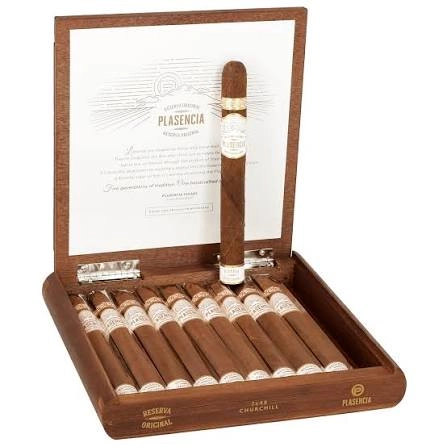
Review of Plasencia Reserva Original Churchill 7x48
Review of Plasencia Reserva Original Churchill 7x48
I want to tell you something that's going to make me sound like an old man yelling at a cloud, and I've made my peace with that. We have lost the ability to wait for things. I say “we” generously, because I include myself first in line. I grew up in a world where you recorded a song off the radio by holding a cassette player up to the speaker and praying nobody in the house picked up the phone and ruined the take. I have stood in a Blockbuster on a Friday night, staring at an empty case where the good movie used to be, genuinely grieving, the way you grieve small, dumb losses that somehow still sting. I know what it is to wait a full week for a roll of film to come back from the drugstore and not find out until you opened the envelope whether Uncle Ray had blinked in every single shot. Instant everything wasn't a birthright for people my age. It was a rumor we heard about, and then one day it just showed up and ate the whole culture in about eighteen months. Somewhere out there right now, a young man is furious his video buffered for four whole seconds, and if I could sit him down with one of these Churchills, I would, purely as an act of mercy.
So when I tell you that patience used to be an ordinary, expected skill and not some rare personality trait people write books about now, understand I paid actual dues to say it. I'm not nostalgic for dial tones and floppy disks, to be clear — I don't miss a single minute of waiting on a modem to connect while it made noises like a dying fax machine. But I do think we lost something real when waiting stopped being a normal part of life and started being an inconvenience to be engineered out of existence. And that's the frame of mind I was in on a Tuesday evening a few weeks back, sitting out at the Oasis with a cigar I'd been saving for the right night — the Plasencia Reserva Original, in the Churchill vitola, seven inches of stick with a 48 ring gauge, which if you're new around here is just a fancy way of saying “long and not too fat.”
I'd been putting this one off for a couple weeks. Not because I doubted it. Because some cigars you smoke because you're bored and the humidor's full and something's got to give, and some cigars you smoke because you want the evening itself to slow down and match the pace of the burn — and this one felt like the second kind before I'd even clipped the cap. You develop an instinct for that after enough years of doing this. Certain cigars ask you to hurry up and enjoy them. This one asked me to sit down and be quiet for a while. I obliged.
Here's the short version, if you're the type who scrolls to the bottom of a recipe just to see if it's worth reading the story first: yes, it's worth it. This is one of the more thoughtful cigars I've put in my hand in a long while, and it earned every minute of the hour and a half it asked me for. Now let's get into why, because the how matters here more than most reviews I write, and I promise you I'm going somewhere with all of this besides just tasting notes.
First Impressions
The Reserva Original comes to you looking like it already knows something you don't. The wrapper is a rustic, dark maduro — not the glossy, almost-lacquered, look-at-me wrappers you see on cigars built to impress you before you've ever lit them — the cigar equivalent of a guy who peaked in the parking lot before the date even started — but something more textured, a little rough under the thumb, the kind of leaf that looks like it worked for a living. There's tooth to it. Visible veins here and there, nothing that concerns me on a stick this well put together — on a cigar this handmade and this honestly farmed, a little texture is a feature, not a flaw. It's the tobacco equivalent of a man with calluses on his hands. You trust it more, not less, and if you've spent any real time around actual working men, you already know exactly what I mean by that.
Here's the detail that actually stopped me before I even lit it, though: this is marketed, and as far as I can tell rightly so, as the world's first organic cigar. Every leaf in this thing — wrapper, binder, filler, all of it — is certified organic tobacco, grown without synthetic pesticides, out of the Esteli and Jalapa regions of Nicaragua, using farming methods the Plasencia family traces back to the Nicarao people, five centuries deep. And then, after the tobacco does its normal aging and fermentation, they let it rest another five years before it ever gets rolled into something you can buy.
Five years. Let that sit with you for a second, because I had to sit with it myself, right there at the Oasis before I'd even taken a single draw. In a culture that gets irritated when a web page takes four whole seconds to load, somebody grew a plant, cured it, fermented it, and then just... waited. Five more years. No rushing it to market to hit a quarterly number. No cutting the process short because the bills were due or a competitor launched first. Just patience, generation after generation, because the Plasencia family has been doing this since the 1800s and they know something the rest of us keep forgetting on a near-daily basis: some things cannot be hurried without being ruined in the hurrying.
The cold draw gave me cedar right away, something almost bread-like underneath it, a little pepper on the back end, and a faint sweetness I can only describe as similar to dried fruit — not candy-sweet, more like something that's been given time to develop its own natural sugars instead of having them added later by somebody in a hurry. Which, again, is thematically appropriate to a fault. This is a cigar that seems to understand its own metaphor before I ever had the chance to write one for it, which honestly made my job a little easier and a little harder at the same time.
The Family Behind the Leaf
Before I get into the actual smoking of this thing, I want to take a minute on who made it, because I think it matters more here than it usually does. The Plasencia name has been attached to tobacco since the 1800s, first in Cuba, then — after the Cuban revolution forced the family to start over from nothing in a new country — in Nicaragua and Honduras. That's not a footnote. That's a family that lost everything once already and rebuilt an entire agricultural legacy from the dirt up, twice, across generations, without ever putting their own name on a cigar box until fairly recently. For most of their history, they were the quiet hands behind other people's brands — growing and supplying premium leaf for some genuinely major names in this industry, doing the unglamorous, unseen work that makes somebody else's finished product possible.
There's something in that I find myself circling back to more than the tasting notes, if I'm honest. Four cigar factories. Eight plantations. Something like six thousand workers producing tens of millions of handmade cigars a year, and it took until relatively recently — five generations in — for the family to finally put their own name front and center on their own brand. That's not overnight success. That's not a viral launch. That's a slow, patient build across more than a century, where most of the generations involved never got to see the payoff of the specific thing they were planting. They planted for a harvest they wouldn't personally reap.
I don't think that's an accident of business strategy. I think that's what real legacy actually looks like when you strip away the highlight reel. It's rarely one person's big moment. It's usually a long relay of people doing faithful, unglamorous work that somebody three generations later gets to finally hold up in the light. If you're in a season right now where you feel like you're doing the unseen, unglamorous groundwork — raising kids nobody's clapping for yet, building a marriage nobody's writing articles about, doing ministry that shows up in no headline anywhere — this cigar is a small, smoky reminder that the people planting the field rarely get invited to the harvest party. They plant anyway. That's the whole job description.
Pack and Light
Construction on the pre-light checks out beautifully. Even density from cap to foot, no soft spots, no hard plugs — the kind of roll that tells you somebody who knew exactly what they were doing had their hands on this before it ever left the factory floor. I clipped the cap with a straight cut, gave myself a little more room than usual since Churchills reward a slightly wider draw, and toasted the foot slow and even, rotating it the way my granddad taught me before he ever knew I'd grow up to write cigar reviews on the internet for a living. Something he definitely didn't see coming. Neither did I, honestly, but here we both are.
The light took evenly on the first pass, no relight required, no scorched or tunneling wrapper — just a clean, confident burn line right out of the gate. First few draws gave a gentle billow of grayish smoke, medium density, and that same cedar-and-pepper combination from the cold draw, now joined by something warmer underneath — almost like fresh-baked bread crust, if bread crust could also throw a gentle, friendly punch on the way down.
First Third
The first third settles in fast, which I appreciate. Some cigars make you wait twenty minutes to figure out what they're actually about, and by the time they finally show their hand you've already decided how you feel about them and they can't win you back. This one tells you early: warm, nutty flavors up front — think roasted almonds, maybe a hint of hazelnut — layered over a woody, earthy base that never gets muddy or one-note the way some medium-bodied cigars can drift into. There's a black pepper spice that shows up on the retrohale, present but never aggressive, the kind of spice that wakes your palate up instead of assaulting it into submission. It's medium-bodied, confidently so — enough presence to know you're smoking something serious, not so much that it bulldozes a conversation happening next to it.
Here's where I have to be honest with you about where my head went, because this is a faith site as much as it's a cigar site, and I'm not going to pretend those two things live in separate rooms of my life just because one of them involves fire and tobacco. There's a verse I've quoted wrong to myself for probably fifteen years, and this cigar is what finally corrected me on it. Galatians 6:9 says, “Let us not become weary in doing good, for at the proper time we will reap a harvest if we do not give up.” For most of my life I heard that verse as pure endurance advice — grit your teeth, keep grinding, the payoff's coming eventually if you refuse to quit. Which isn't wrong, exactly. But it's incomplete, and I only noticed the gap sitting there at the Oasis with five years of patient aging curling up in front of my face like it had something to say to me.
The verse doesn't say “keep doing good and eventually you'll feel like doing more good.” It says at the proper time. There's a proper time built directly into the promise — not “whenever you finally get tired of waiting,” but a time that isn't yours to set, negotiate, or move up because your patience is running thin. The Plasencia family didn't get to decide the tobacco was ready in six months because the bills were due or the market window looked good. They waited for the leaf to actually become what it was capable of becoming, on a timeline they didn't control and couldn't rush, because rushing it would have produced something objectively lesser — you can taste haste in bad tobacco the same way you can taste it in a rushed marriage apology or a sermon somebody wrote an hour before service. I think most of us — and I'm including every version of myself from the last thirty years in this, no exceptions — treat our own formation like we're allowed to skip the fermentation step. We want the harvest without the five years in the barn. We want the flavor without the patience that actually built it. And I don't think God works that way, and frankly, neither does good tobacco, and I find it strangely comforting that both of those truths agree with each other.
That's not me being precious about a cigar. That's me telling you the truth about what a genuinely good cigar will do to you when you actually sit still long enough to let it talk instead of just consuming it like everything else you consume in a given day without noticing.
Second Third
The midpoint is where the Reserva Original really shows its hand, and where I stopped taking notes for a good fifteen minutes because I got a little too caught up in it, which I suppose is its own kind of review. The nutty sweetness from the first third deepens into something closer to dark chocolate, and the earthiness picks up a leather note that wasn't there before — not sharp, more like an old baseball glove that's been broken in over decades of actual use rather than bought pre-distressed at a store. The pepper backs off slightly, making room for a subtle coffee character on the finish, and every so often, if you catch it right, there's a flash of something almost like dried cherry or fig underneath everything else. It never overstays its welcome. Every flavor shows up, does its part, and steps back to let the next one through, like a well-run relay team instead of five guys all trying to grab the baton out of each other's hands at once.
Burn line stays razor straight through this section, ash holding in long, silvery-gray segments — I got a solid two and a half inches before it finally let go on its own terms, which for a cigar this size tells me the tobacco was packed with real consistency and not just good intentions and a nice box. No touch-ups needed. No relights. Just steady, even combustion the whole way through, the kind that lets you actually relax into the smoke instead of babysitting it like it might quit on you at any second.
There's a particular kind of masculine friendship that only shows up around something slow like this — a cigar, a fire pit, a long drive with no real destination in mind — and the second third of a cigar this size is where that friendship usually starts showing up in real conversations, if you've got somebody with you that night. I had company, an old friend from my first-responder years, and we didn't say much of substance for the first twenty minutes. Just weather, work, the usual throat-clearing men do before they get around to anything real, the verbal equivalent of two dogs circling each other before they decide it's safe to lie down. But somewhere around the midpoint of these cigars, when the ash gets heavy and you both start watching it instead of each other, something in the air always shifts. That's not the cigar's flavor profile talking. That's just what slow things do to people who let themselves slow down alongside them.
Final Third
The final third brings the strength up a notch, as good Churchills tend to do, without ever tipping into harsh or bitter territory — no bite, no ammonia, none of the unpleasant sting some full-bodied cigars deliver right at the exact point where you're most committed to finishing them and least willing to quit. The earthy, leathery core carries through to the band, joined now by a deeper roasted quality, almost like the difference between a light roast and a dark roast coffee bean — same plant, same DNA, just further along in its own particular process. The natural sweetness holds on longer than I expected, keeping the whole experience balanced instead of letting the final stretch turn into a slog of pure pepper and char, which is where a lot of lesser cigars lose me right at the finish line when they've got nothing left in reserve.
By the time I got down to the last couple inches, close to ninety minutes had passed since I first clipped the cap. Ninety minutes is a real chunk of a Tuesday evening in a world that will happily fill every spare minute you hand it with a screen. It's also, not coincidentally, about how long it takes for a real conversation to actually get somewhere — past the small talk, past the “how's work” and into the parts of life people don't usually volunteer unless the setting gives them permission and enough runway to get there without feeling rushed toward it. This cigar gives you that runway. That's not marketing language. That's just what a cigar built to take its time will do for the people sitting around it, whether they showed up planning on a deep conversation or not.
Why the Organic Part Actually Matters
I'll admit, the first time I saw “world's first organic cigar” on a label, some part of me rolled my eyes a little. I've been around long enough to watch “organic” get slapped on everything from cereal to shampoo as a pure marketing play, and I've gotten understandably cynical about the word. At some point “organic” started showing up on bottled water, which is a substance that is, definitionally, already just water, so forgive my skepticism. But the more I sat with this one, the more I think the organic angle here isn't a marketing hook at all — it's the whole point, and it connects back to something I actually believe pretty deeply.
Genesis 2:15 says God put the first man in the garden “to work it and take care of it.” Not to strip-mine it for the fastest possible yield. Not to extract everything it could give as quickly as chemistry would allow. To work it and take care of it — cultivate and steward, in the same breath, like the two things were never supposed to be separated in the first place. Somewhere along the way, a lot of modern agriculture decided those two jobs could be split apart — maximize the yield now, worry about the soil later, spray whatever gets the harvest in faster. The Plasencia family, whether they'd frame it in exactly these terms or not, seems to have kept those two jobs stitched together the way they were originally intended to be. No synthetic pesticides. Traditional growing methods passed down five centuries. Soil that gets treated like something worth taking care of rather than something to be used up and moved past.
You can taste the difference, or at least I believe I could, sitting there with it. There's a cleanness to the flavor profile, a lack of anything harsh or chemical riding underneath the natural tobacco taste, that I don't get from every cigar I smoke. Maybe that's real. Maybe some of it's the story talking louder than my palate. I'll leave that argument to people with more sensitive taste buds than mine. But I know this much for certain: stewardship — actual, patient, generational stewardship of land and leaf and legacy — produces something different than extraction does, every single time, in tobacco and in every other area of life I've ever paid close attention to.
What This Has to Do With Brotherhood
I've talked before, on this site, about the five things I keep coming back to when I think about what real community between men is supposed to look like: Truth, Brotherhood, Hope, Humility, Honor. I didn't invent that list to sound tidy on a graphic for the Facebook group. I built it out of thirty years of watching what actually holds men together when the easy seasons end and the hard ones start, and I noticed, sitting with this particular cigar, that it happens to be a decent five-point review of the tobacco itself, if you squint.
Truth, because the Reserva Original doesn't dress itself up as something it's not. No glossy wrapper hiding a mediocre blend underneath, no marketing gloss standing in for actual quality. What you get in the smoke is exactly what the label promises, nothing inflated. Brotherhood, because a cigar like this practically demands company — I don't think I've ever smoked one of these completely alone, and I'm not sure I'd want to. Hope, because five years of patient aging is, structurally, an act of hope. Nobody plants a crop and waits half a decade on a guarantee. They wait on a conviction that the wait is worth it. Humility, because for all the pedigree behind this family and this leaf, there's nothing showy or self-important about how the cigar actually presents itself — rustic wrapper, no flash, just quiet quality doing the talking. And Honor, because a family that spent a century supplying leaf for other people's names before finally putting their own on the box understands something about paying your dues that a lot of us could stand to relearn.
I bring all that up because I think it's easy to read a cigar review and assume the point is the cigar. It never really is, not on this site anyway. The point is what the cigar gives you room to notice about yourself, your friendships, and the pace you've been running your life at without ever agreeing to it. If you're looking for a reason to invite a guy over, sit down at the Oasis, and let a conversation go somewhere real instead of staying shallow, this cigar is as good an excuse as any I've found this year. Better than most, honestly.
Construction and Performance
Here's the technical rundown, for those of you who came here for the numbers as much as the reflection — and both of you are equally welcome at the Oasis, no judgment either way.
● Burn: Even and razor-straight from foot to nub, with no touch-ups required across the full smoke, start to finish.
● Draw: Ideal resistance — not tight enough to work for it, not loose enough to overheat the smoke or blow through the tobacco too fast and waste what you paid for.
● Ash: Solid, tight, silvery-gray, holding in sections of two-plus inches before dropping clean, almost in one piece, onto the ashtray — which, if you've ever watched a grown man get genuinely emotional about ash retention, you already know is a bigger deal in this hobby than it has any right to be.
● Smoke Output: Generous and consistent, thick enough to satisfy without turning the whole Oasis into a smokehouse the neighbors start complaining about.
● Strength: Medium-bodied through the first two thirds, stepping up to medium-full by the finish — approachable for guys newer to fuller cigars, satisfying for guys who've been at this a while and know what they like.
● Smoking Time: Right around ninety minutes at a relaxed, unrushed pace, which is exactly what a Churchill this size should give you if you let it.
● Consistency: I've had two of these now, a few weeks apart, from the same box, and both performed almost identically — which matters more than people give it credit for when they're rating a cigar. A cigar that's great once is luck. A cigar that's great twice, under different conditions, on different nights, is craftsmanship you can actually count on.
If you're the type who cares that this comes from a family that's been growing tobacco in Nicaragua and Honduras since the 1800s, and who supplies leaf to some genuinely major names in this industry before ever putting their own name on a box, that pedigree shows up plainly in the construction. This isn't a company's first attempt at getting a roll right. This is five generations of hard-earned practice showing up quietly in your hand.
Value
Pricing on the Reserva Original Churchill generally runs in the low-to-mid double digits per stick, depending on where you find it — solidly in “regular rotation for a special evening” territory rather than “grab a handful for a random Tuesday” territory, though I'll be honest with you, I smoked mine on a Tuesday and didn't regret a single dollar of it. Given the organic certification, the extended five-year aging process, and the family pedigree behind the leaf, I think this cigar earns its price tag rather than coasting on the “world's first organic cigar” headline alone to justify the cost. You are paying for patience here, plain and simple, and patience, it turns out, is not cheap to manufacture — not in tobacco, and not in a person either, if you've ever tried to build any of it in yourself. Meanwhile we'll happily drop seven dollars on a coffee named after a Christmas song and call that a treat, so let's not pretend we don't have the money — we just spend it on worse patience-avoidance strategies.
I wouldn't call this an everyday smoke, price-wise, but I also wouldn't call it a strictly special-occasion-only cigar either. I'd call it a “you decided this particular evening was worth honoring” cigar. Keep a few in the humidor for the nights you already know are going to matter — a hard conversation you've been putting off, a good one you've been looking forward to, or a quiet one where you don't need to say much of anything, you just need something steady in your hand while you think.
Pairing Recommendations
This cigar wants something with weight and warmth to match it, not something that competes for attention or tries to steal the scene. A good bourbon with some age on it does the job beautifully — something in the same spirit as the tobacco itself, unhurried and confident in exactly what it is, no apologies offered. If you're more of a coffee guy, a dark roast black coffee pulls out the roasted, chocolatey notes in the second and third act especially well, and gives you something to hold onto with the other hand. For something a little different, a glass of aged rum picks up on that dried-fruit sweetness from the cold draw and carries it all the way through the smoke, right to the band.
And if none of that's your speed, plain water works fine too. Some nights the cigar doesn't need help from anything in a glass. It just needs you to show up, sit down, and actually pay attention for once.
The Verdict
Yes. Without hesitation, yes. The Plasencia Reserva Original Churchill is a genuinely excellent cigar — well-constructed, flavor-forward without ever being showy about it, and built by people who clearly still believe patience produces a better product than shortcuts ever will. It's not the loudest cigar on the shelf. It doesn't need to be. It's the cigar equivalent of a man who's done the work quietly for thirty years and doesn't need to announce a single bit of it to anybody, because the results already speak for him every time he shows up.
If you're newer to fuller-bodied cigars, this is an excellent, approachable entry point into that world without throwing you into the deep end. If you've been doing this a while, this is a cigar that'll remind you why you fell in love with the slow version of this hobby in the first place, back before everybody wanted the shortest, fastest, cheapest version of everything, including their own hobbies, including — if we're honest — their own faith.
Coming Back Around
I told you at the start I was going to sound like an old man yelling at a cloud, and I stand by that, mostly because I think the cloud has earned some yelling lately. We are, collectively, terrible at waiting. We want the answer before we've finished asking the question. We want the breakthrough before we've sat through the boring middle part where the actual growth quietly happens, out of sight, underground, where nobody's clapping yet. I include myself in every one of those sentences, no exceptions, no asterisks, no letting myself off the hook because I write about this stuff for a living.
But here's what a good cigar and about five thousand words taught me on a random Tuesday night: some of the best things in this life, and I'd argue in the next one too, don't arrive on our schedule. They arrive on a schedule set by Someone who knows exactly how long real formation takes, whether that's five years of tobacco aging quietly in a barn in Esteli, or however many years it's taking you to become the man, the father, the husband, the friend you're actually being shaped into right now, today, in whatever slow, frustrating season you're currently in the middle of. The proper time is coming. It's not late. It was never late. It's just not yours to schedule, and it never was, no matter how many productivity systems we invent trying to prove otherwise, complete with color-coded apps that gamify hydration and sleep like we're all training for some competition nobody signed up for.
My friend and I didn't solve anything out at the Oasis that night. We didn't need to. We just sat there, let two good cigars burn all the way down at their own pace, and let ninety minutes actually be ninety minutes instead of trying to compress it into fifteen because we both convinced ourselves we had somewhere else to be. Turns out we didn't. Turns out most nights, if you actually stop and check, you don't either.
Pull up a chair sometime. The Oasis is always open, and there's almost always a second cigar in the box, waiting on somebody to sit down and take their time with it.
Follow along on Instagram, Facebook, and Twitter/X for more reviews, stories, and the occasional bad dad joke. And come find the long-form stories and the book-in-progress over at BrownsLife.com.
And don't forget to visit BrownsLifeOasis, for more articles on faith, family, and finding your rhythm in a chaotic world.